






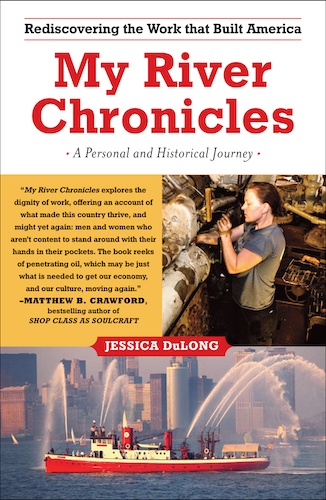

MY RIVER CHRONICLES
Rediscovering the Work that Built America
A Personal and Historical Journey

**Winner, 2010 ASJA Outstanding Book Award, Memoir**
by Jessica DuLong
A celebration of craftsmanship and hands-on work, MY RIVER CHRONICLES is a deeply personal story of a unique woman's discovery of her own roots-and America's-that raises important questions about our nation's future.

"An engaging narrative"-The New York Times
"Elegantly written"-Gay Talese
"Powerful reading"-Kirkus, starred review

PRAISE | PRESS | EXCERPTS | EVENTS | BUY

BLOG

Too Cool for School? Examining the Case Against College

Friday, August 27, 2010 - Save & Share - Leave a Comment

Earlier this month Forbes magazine published a piece about a controversial question that has garnered increasingly more mainstream attention: “Should nearly everyone go to college?” I’ve mentioned this quandary in other pieces [link to bio pg on huffpo with links to all posts] but haven’t addressed the issue head-on until now. Here’s a snippet from my latest HuffPo piece:

It’s heresy for someone like me to suggest that a liberal arts education isn’t always the answer. After all, I was privileged to receive top-notch schooling from Phillips Exeter Academy and Stanford University. Generous financial aid packages granted this mechanic’s daughter access to the esteemed institutions that taught me how to read, how to think, how to write. For the record, I firmly believe that everyone who wants to pursue scholarship of this sort should have the opportunity to do so. Period. But the reality is, not everyone does. And classrooms are not the only (or even, necessarily, the best) places to learn.

I, for one, received my most important training for my current position — chief engineer of a retired 1931 New York City fireboat — on the job, through a decade-long, hands-on apprenticeship. Before I began working aboard Fireboat John J. Harvey, I used to pressure my younger siblings to go to college: “You want to keep all your options open. It’s the only way to get ahead.” I had drunk the College Kool-Aid. But soon, my own apprenticeship transformed my thinking about the future facing not just my siblings, but society as a whole.

As always, I welcome your comments. Surely, questions of education will continue to rile and rally a diversity of opinions. I hope you’ll share yours.

Filed in Fireboats, Jobs, Manufacturing, Unemployment • Tags: , , , ,

1848 Daguerreotypes bring Cincinnati waterfront back to life

Wednesday, August 18, 2010 - Save & Share - Leave a Comment

As someone who discovered a latent love of history through falling for the Hudson River, I was awed by the magic and revelation contained in these 1848 Daguerreotypes, which experts have recently discovered reveal precise, intimate details of Cincinnati waterfront life in the mid-19th century.

Produced by Charles Fontayne and William Porter, the panorama spans some 2 miles of Cincinnati shoreline, showing the technology and industries of the age and capturing images of individuals in the midst of daily routines. As Julie Rehmeyer writes in Wired:

Fontayne and Porter were definitely skilled, but no one knew just how amazing their images were until three years ago, when conservators at George Eastman House in Rochester, New York, began restoration work on the deteriorating plates. Magnifying glasses didn’t exhaust their detail; neither did an ultrasharp macro lens. Finally, the conservators deployed a stereo microscope. What they saw astonished them: The details—down to window curtains and wheel spokes—remained crisp even at 30X magnification. The panorama could be blown up to 170 by 20 feet without losing clarity; a digicam would have to record 140,000 megapixels per shot to match that. Under the microscope, the plates revealed a vanished world, the earliest known record of an urbanizing America.

How cool is that?

Filed in Craftsmanship, Hands-on work, History, Manufacturing, Preservation • Tags: , , , , , , , , , , , ,

New York Times calls My River Chronicles “an engaging narrative”!

Monday, August 16, 2010 - Save & Share - Leave a Comment

Standing in the engine room of Fireboat John J. Harvey yesterday, I settled in for the five-hour trip home to NYC after our weekend in Cold Spring, NY to celebrate the town’s new open dock policy.

I pulled my iPhone from the pocket of my Carhartts for a quick email check—already bracing myself for being back at my desk on Monday morning.

There I discovered that The New York Times reviewed My River Chronicles: Rediscovering the Work that Built America; A Personal and Historical Journey.

Here’s what Sam Roberts had to say:

“As American society continues to become more virtual, less hands-on,” Jessica DuLong writes, “I’m a salmon swimming upstream.” Ms. DuLong did her figurative swimming as a licensed engineer on a decommissioned 130-foot-long fireboat on the Hudson and as part of the crew that served at ground zero.

She delivers an engaging narrative of maritime history and her own hands-on perceptions in My River Chronicles: Rediscovering the Work That Built America: A Personal and Historical Journey (Trade paperback, $16).

No one could see me jumping for joy in the engine room.

Filed in Fireboats, Hands-on work, Hudson River, My River Chronicles, Press, September 11 • Tags: , , , , , , , , ,

Washington Post Op-Ed Discusses Manufacturing and Multinationals

Friday, August 13, 2010 - Save & Share - Leave a Comment

In their op-ed in today’s Washington Post, Robert M. Kimmitt and Matthew J. Slaughter make a critical point about the role of manufacturing in a sustainable economic future:

As we recover from the global financial crisis, America’s economy needs to be rebalanced away from consumption demand and toward capital investment and exports. Manufacturing can play a key role in this process.

Yet they also argue that the U.S. operations of multinational companies based here and abroad strengthen domestic manufacturing:

Despite the common assertion that U.S. multinationals simply “export jobs” out of the United States, these firms’ expansion abroad has tended to complement their U.S. operations.

I look forward to hearing the uproar that rises up from this assertion.

And when I read this:

In many U.S. multinationals, foreign and U.S. operations support and strengthen each other. A major reason for this is faster economic growth outside the United States. Rapidly growing countries present vast revenue opportunities for U.S. multinationals, opportunities that tend to boost affiliate and parent activity.

I again found myself wondering, “vast revenue opportunities” for whom, really? And how does this argument impact the growing gap between haves and have-nots in this country, and the fate of the American Dream?

Filed in Jobs, Manufacturing, Unemployment • Tags: , , , , , , , ,

Wall Street Journal Blames Unemployment on the Unemployed?

Monday, August 9, 2010 - Save & Share - Leave a Comment

For a serious lesson in journalistic slant, compare today’s Wall Street Journal story about the skills gap with last month’s New York Times piece.

Despite a 9.5% jobless rate and some 15 million Americans looking for work, the WSJ piece explains, many employers are having trouble filling open positions. All true (well, except for the ACTUAL joblessness rate [video via Crooks and Liars]  but that’s another issue entirely). But instead of addressing the cultural climate that demeans many of the types of industries struggling to find skilled workers, the Journal blames the jobless for their plight, painting a picture of the unemployed as lazy good-for-nothings happy to live off the dole:

“Extending jobless benefits to 99 weeks gives the unemployed less incentive to search out new work.”

Where have we heard this rhetoric before? The piece goes on to give an example:

“Some workers agree that unemployment benefits make them less likely to take whatever job comes along, particularly when those jobs don’t pay much. Michael Hatchell, a 52-year-old mechanic in Lumberton, N.C., says he turned down more than a dozen offers during the 59 weeks he was unemployed, because they didn’t pay more than the $450 a week he was collecting in benefits. One auto-parts store, he says, offered him $7.75 an hour, which amounts to only $310 a week for 40 hours.”

Man, those picky blue-collar workers. They’re just too stubborn and/or lazy to not just accept whatever scraps the job market might fling their way. Instead they decide to live high on the hog, making the equivalent of $23,400/year—that is, until the benefits dry up. Then they’ll be back to choosing between food, rent, transportation, and health care instead.

How refreshing would it be if jobs of all types (not just those occupied by the majority of WSJ readers) offered a living wage?

Filed in Jobs, Manufacturing, Unemployment • Tags: , , , , ,

What Giving Half Says About the Wealth Gap … And Us

Friday, August 6, 2010 - Save & Share - Leave a Comment

In my latest Huffington Post piece, I mentioned a statistic that merits more than a passing nod:

In 2008, nearly 50 million people in this country (including 16 million children) lived in food-insecure households.

Go ahead. Take a moment to fully grasp that figure. (And while you’re at it give some thought to what you’ve had the privilege of putting in your belly today.) Fifty million people translates to one out of every six of our neighbors. What does that tell us about our priorities as a nation?

Now juxtapose that stat with the news that 40 of America’s richest citizens have pledged to donate at least half of their wealth to charity.

A noble act, to be sure—especially since pack leaders Warren Buffett and Bill and Melinda Gates are trying to rally others of the nation’s billionaires to the cause. But, as Robert Reich aptly points out, the “half” pledge is also a disturbing reminder of just how much money lies in so few hands. In an era where the average executive makes 300 to 500 times the average worker, the gap between this country’s haves and have-nots is expanding at an alarming rate.

So far, the 40 richest have pledged $125 billion. When the conversation shifts to dollar amounts containing that many zeros, it’s easy to feel pretty detached pretty quickly. But consider the Salwen family, whose book The Power of Half: One Family’s Decision to Stop Taking and Start Giving Back recounts their choice to sell their Atlanta mansion, downsize to a smaller house, and give half of the profits to a worthy charity. Okay, words like ‘mansion’ still make it easy to think that kind of giving is only for rich people. And maybe it is.

Or maybe we could, all of us, put a little thought into what comforts and/or luxuries we’d be willing to sacrifice so that our neighbors might have the basics, like food on the table. As Hannah Salwen, the high school junior who convinced her family to sell their house, told the NYT:

“Everyone has too much of something, whether it’s time, talent, or treasure. Everyone does have their own half, you just have to find it.”

Filed in Jobs, Unemployment • Tags: , , , ,

Message in a Bathtub: Does the Death of the Middle Class Spell the End of the American Dream?

Thursday, August 5, 2010 - Save & Share - Leave a Comment

When I read this story from the Philadelphia Inquirer the other day, I knew I had to write about it. An official from Philadelphia Christ Church went searching for a water leak and wound up discovering an 80-year old message scrawled in pencil on the back of a bathtub:

“Tub set 1-9-33 by Louis J. Volpe. This work kept two men from starving during the Depression.”

Volpe’s message started me thinking about the simple power that skilled-trades jobs have always had to put food on American tables, and the consequences of today’s ever-widening gap between haves and have-nots. The resulting Huffington Post piece seems to have struck a nerve. It was featured on the front page of HuffPo’s Impact section. Here’s an excerpt:

Today fewer Americans may be starving to death than during the Depression, but that doesn’t mean U.S. workers aren’t struggling to make ends meet. In 2008, nearly 50 million people in this country (more than 16 million of them children) lived in food-insecure households. Without income sufficient to cover basic needs, many families are forced to choose between food and other necessities, such as housing, healthcare, childcare, and transportation. And things are not getting better.

Each year the gap between this country’s haves and have-nots continues to grow. In this weekend’s Financial Times, Edward Luce picked apart the American Dream, profiling families whose stories paint a portrait of the dying middle class. Among those mentioned were Mark and Connie Freeman. Although their joint gross income of $70,000 is more than a third higher than the U.S. median, the couple says they’re “never more than a pay check or two from the streets.”

This story is far from unusual.

Check out the rest at HuffPo. And, as always, I welcome your comments on the HuffPo post page.

Filed in Jobs, Unemployment • Tags: , , , ,

Learning From Shirley Sherrod: Finding Common Ground With the Working Class

Thursday, July 29, 2010 - Save & Share - Leave a Comment
Despite the media’s obsession with perpetuating divisive partisan politics, we actually have more common ground with our fellow citizens from all along the political spectrum that we sometimes think. Whether or not you’ve chalked up the Shirley Sherrod controversy as just another distraction tactic, I hope you’ll concede that the full version of the white farmer story she told during her NAACP speech contained a valuable lesson.


I highlight that take-home message in my latest HuffPo piece. Here’s a snippet:

On Sunday, Washington Post columnist Michelle Singletary brought up an important issue that seems to be getting lost in the midst of all the Shirley Sherrod hoopla: What was Sherrod actually trying to say in her NAACP speech that day? Despite what the edited video that cost the Department of Agriculture official her job portrayed, Sherrod’s take-home message wasn’t promoting race-based division, but quite the opposite. Instead she pointed out the importance of recognizing the injustice that affects people of all races, across the political spectrum: Economic inequality.

“The struggle,” she said, 17 minutes into the full video, “is really about poor people. …It’s about those who have versus those who don’t.”

People like that farmer Sherrod mentioned—along with so many other white, blue-collar folks in this country—have suffered severe economic losses over the past several decades. And those losses, some are arguing, have resulted in shifting political allegiances.

I then go on to discuss a new bipartisan poll that reveals how self-identified Democratic, Republican, Independent, and Tea Party voters all want the same thing: for Washington to promote manufacturing and create more manufacturing jobs.

Please let me know what you think in the HuffPo comments! The impacts of class issues on this country’s political and economic landscape have gone unacknowledged for far too long.


Filed in Jobs, Manufacturing, Uncategorized, Unemployment • Tags: , , ,

New York Times Close-Up of My River Chronicles

Thursday, July 22, 2010 - Save & Share - Leave a Comment

So I finally managed to get the video of my recent NY1 interview where I talk with Sam Roberts of The New York Times about my path to becoming a marine engineer aboard fireboat John J. Harvey, the importance of hands-on work in this country, and my book, My River Chronicles. Check it out!


Such a great experience.

Filed in Fireboats, Hands-on work, Hudson River, My River Chronicles, Press • Tags: , , ,

How Innovation, Not Cheap Labor, is the Key to Success in Manufacturing

Monday, July 19, 2010 - Save & Share - Leave a Comment

People from all sides of the debate (including me) have been arguing over the impact of offshore manufacturing since Andy Grove wrote his moving piece arguing that the U.S. needs to produce more goods domestically. But this Newsweek piece by Rana Foroohar really nails the critical issues, bringing to light a new report that provides data instead of just opinion.

The bottom line? “[I]t’s innovation, not how cheap or expensive labor is, that determines whether a country will be successful in manufacturing.” Via Newsweek:

Contrary to conventional wisdom, manufacturing has not become a race to the bottom. That’s why the U.S. still ranks as the fourth-most competitive nation after China, India, and South Korea, despite vastly higher labor costs. Germany, Japan, and Singapore also hold positions in the top 10. The skill levels of their workers more than offset their costs (U.S. workers are twice as productive as those in the next 10 leading manufacturing economies). Skills are particularly critical in the lucrative high-end manufacturing sector, which accounts for about half of all new innovation within an economy. “Talent will be the oil of the 21st century,” says Council on Competitiveness president Deborah L. Wince-Smith.

Foroohar also makes a point about education that bears repeating:

There are measures the United States can take to shore up its position, though predictably, they aren’t easy. While it’s not politically correct to suggest that perhaps every citizen shouldn’t aspire to a university degree, high-end technical schools that can turn a $16,000-a-year dishwasher into a $60,000-a-year welder may in fact deserve as much private and public money as mediocre four-year liberal-arts colleges churning out students with relatively useless degrees. That idea has worked in Germany, though the Germans have also done a good job producing top-level engineers—another area where the United States lags. A much stronger K–12 focus on math and science would help the U.S. greatly.

Politically correct or not, Foroohar has the right idea. It’s time that we in this country stopped denigrating skilled hands-on work, and valued equally the training programs that will equip the nation with the next generation of skilled hands that are crucial for building, repairing, maintaining and innovating the nation’s infrastructure. People learn in all different ways, and the best education doesn’t always take place in a classroom setting.

Having earned a university degree then gone on to pursue a years-long apprenticeship in the engine room of Fireboat John J. Harvey, I speak from personal experience. Sure, the work that I do personally doesn’t keep power on the grid, but plenty of other trades play a key role in the everyday lives of all Americans. What a difference it would make if apprenticeships again garnered the respect they once had for building the skills that keep our country moving.

Filed in Craftsmanship, Hands-on work, Jobs, Manufacturing, Unemployment • Tags: , , , ,